Section 6107. Hearings.
Section 6107 describes how hearings are to be conducted. One important thing to know concerning these hearings is that they are civil hearings in a civil (not criminal) court. It is important to understand this because the rules are very different than those you may see in television courtroom dramas. The rules of evidence are much different in civil court than in criminal court. There is no discovery process in which the accuser has to inform the accused before the hearing of evidence that will be presented. This makes it extremely difficult for people to defend themselves, especially when the accuser is willing to fabricate stories. Defendants may have absolutely no idea what they will need to defend themselves against. Witness lists are also not required to be exchanged. Thus, it is again challenging for people to defend themselves by calling witnesses that might contradict the accuser’s witnesses. Additionally, the defendant or the defendant’s attorney will not have a chance to prepare to cross-examine any witness.
These hearings are not allotted much court time, and the judge will likely push things along. This again makes it very difficult for the defense. If new accusations are made during the hearing, an attorney will have almost no chance to discuss them with the defendant. In this regard, it is almost better to represent yourself as the defendant or at least have an attorney willing to allow you to participate in cross-examining witnesses. However, the judge may not allow this.
There will, of course, be no jury, and the decision whether or not to issue an order and for how long that order will remain in place is made by a single, elected judge. This is a crucial flaw in the system that I discuss throughout this book.
Sub-section (a) provides the general rules as to how hearings determining if a PFA order should be granted should be conducted.
- (a) General rule.–Within ten business days of the filing of a petition under this chapter, a hearing shall be held before the court, at which the plaintiff must prove the allegation of abuse by a preponderance of the evidence. The court shall, at the time the defendant is given notice of the hearing, advise the defendant of the right to be represented by counsel, of the right to present evidence, of the right to compel attendance of witnesses, of the method by which witnesses may be compelled, of the possibility that any firearm, other weapon or ammunition owned and any firearm license possessed may be ordered temporarily relinquished, of the options for relinquishment of a firearm pursuant to this chapter, of the possibility that Federal or State law may prohibit the possession of firearms, including an explanation of 18 U.S.C. § 922(g)(8) (relating to unlawful acts) and 18 Pa.C.S. § 6105 (relating to persons not to possess, use, manufacture, control, sell or transfer firearms), and that any protection order granted by a court may be considered in any subsequent proceedings under this title. This notice shall be printed and delivered in a manner which easily attracts attention to its content and shall specify that child custody is one of the proceedings where prior protection orders may be considered.
First, it says that a hearing must be held before the court within ten business days of filing the petition. During the hearing, the accuser must prove the allegation(s) of abuse by a “preponderance of the evidence.” This is a much lower burden of proof than what must be proven in a criminal trial, i.e., “beyond a reasonable doubt.” According to Wikipedia:
The [preponderance of evidence] standard is met if the proposition is more likely to be true than not true. The standard is satisfied if there is greater than fifty percent chance that the proposition is true. Lord Denning, in Miller v. Minister of Pensions, described it simply as “more probable than not.”
“Clear and convincing evidence” is another higher level of burden of persuasion than “preponderance of the evidence” that is often used in civil court. However, the Pennsylvania legislature made it such that a judge basically only has to believe the accuser more than the defendant to grant the petition and issue an order.
The second statement contains much of the important content of this subsection and attempts to establish some of the procedures for the hearing. Defendants are supposed to be advised of all this information when they are informed of the hearing, which I suspect in most cases is when they are served with the order. I do not recall being told any of this, but it was a very tumultuous time. The Notice of Hearing–shown in the image gallery–only contains information about relinquishing firearms and obtaining an attorney.
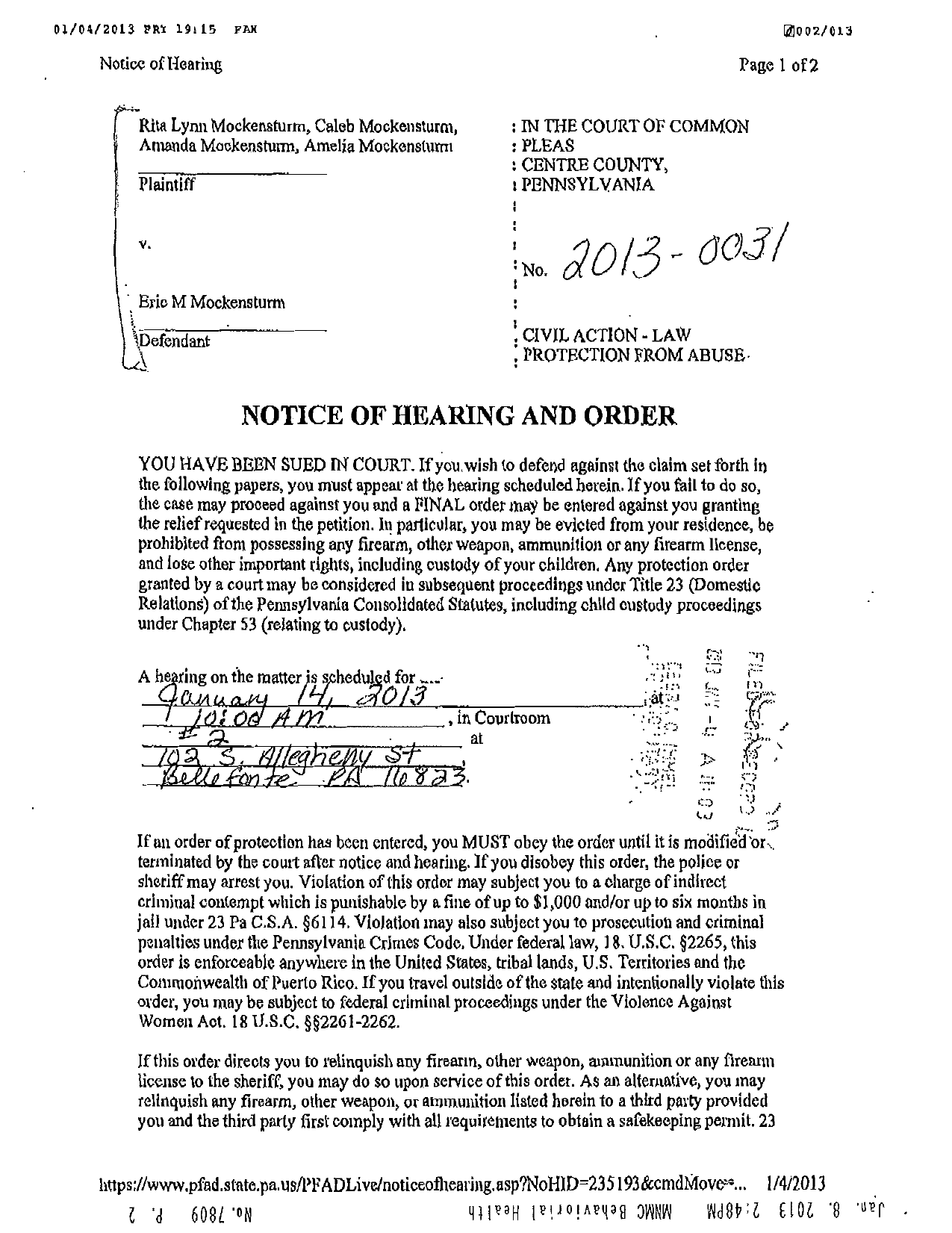
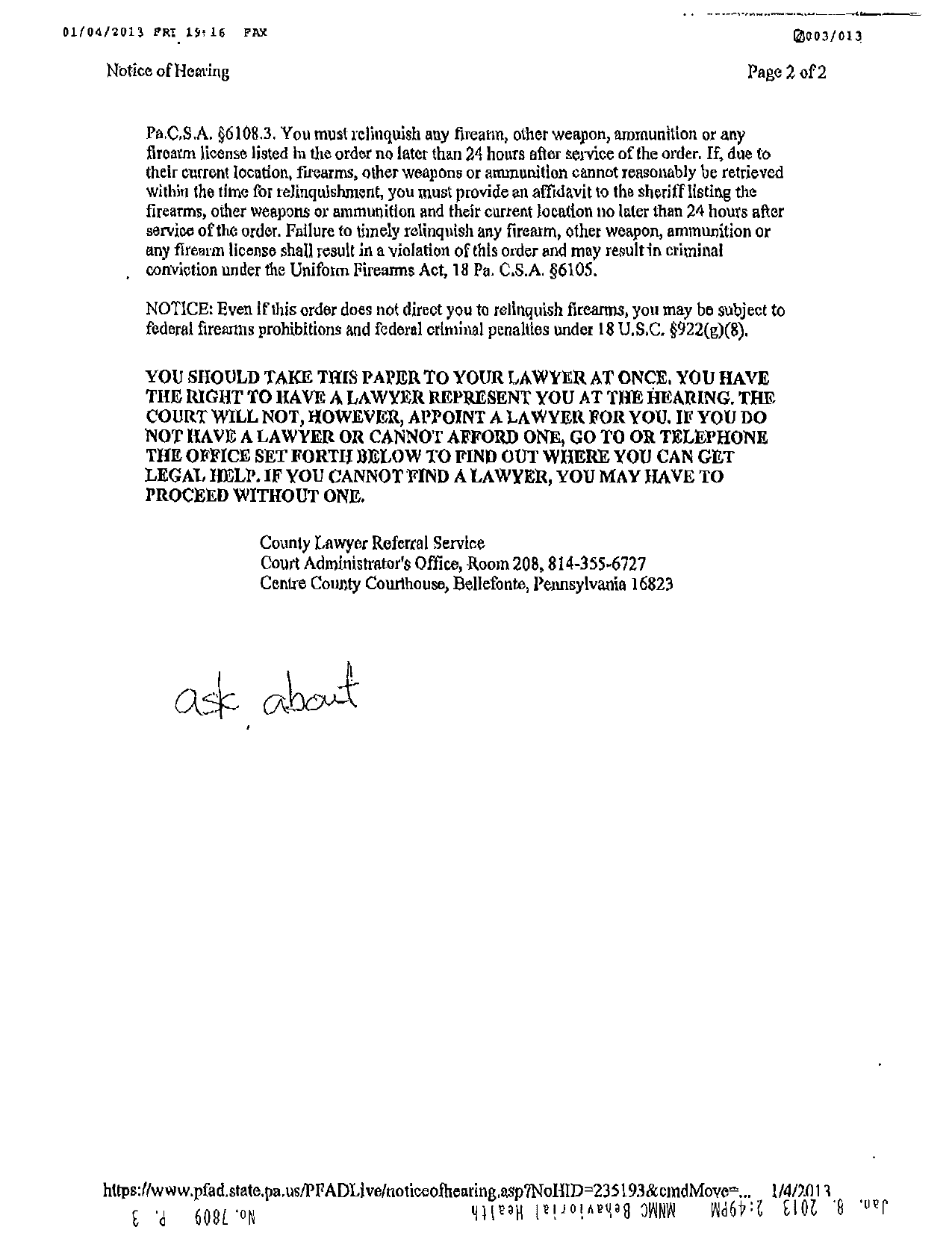
The sentence first appears to state that you have the right to be represented by an attorney unlike in other civil hearings. This is a fascinating statement which deserves some scrutiny and is a good illustration of how courts interpret laws. I believe when most people read this statement, they assume, as I did, that if you could not afford an attorney, one would be provided. However, this is not what it says and not how the courts interpret it. Note that when criminal defendants are read their rights, the arresting office also states, “If you cannot afford an attorney, one will be appointed to you by the state.” That is not what is stated here, and one thing the hearing notice makes clear in bold, capitalize text is that:
YOU SHOULD TAKE THIS PAPER TO YOUR LAWYER AT ONCE. YOU HAVE THE RIGHT TO HAVE A LAWYER REPRESENT YOU AT THE HEARING. THE COURT WILL NOT, HOWEVER, APPOINT A LAWYER FOR YOU. IF YOU DO NOT HAVE A LAWYER OR CANNOT AFFORD ONE, GO TO OR TELEPHONE THE OFFlCE SET FORTH BELOW TO FIND OUT WHERE YOU CAN GET LEGAL HELP. IF YOU CANNOT FIND A LAWYER, YOU MAY HAVE TO PROCEED WITHOUT ONE.
Thus, you have the right to be represented by a lawyer, just as you have the right to wear a tie to the hearing. The courts have decided that even though the law explicitly states that you have the right to an attorney, it is really simply stating the obvious and merely means that you can have an attorney. The office provided for legal assistance is simply the County Lawyer Referral Service in the Court Administrator’s Office.
If the legislature did not mean that the state would provide an attorney if necessary, then I’m not sure why it is even stated. It would be interesting to research the history, including the debate that occurred of this section of the law, to see why the authors felt the need to include this. If a female accuser does not have an attorney, I believe the women’s resources center in most counties will provide one at no charge.
The second clause clarifies that the defendant has a right to present evidence and compel witnesses to testify. It also states that defendants should be advised of the method by which they may compel witnesses. While I do not recall being explicitly told any of this, I must have assumed I could have asked witnesses to testify on my behalf. Ultimately, it never came to this, and I really don’t know who I would have asked to testify.
Interestingly, it specifically states that defendants are to be told how to compel witnesses to testify. This is normally done with a subpoena, and it may be that is what defendants are told; however, subpoenas take time to obtain, and witnesses typically have 21 days to respond. This timing is clearly at odds with the ten-day requirement for the hearing. Thus, maybe there are other methods to compel witnesses to testify.
The rest of the sub-section primarily deals with firearms. The hearing notice also clarifies that the defendant may have to relinquish any firearms, ammunition, or licenses. It also states that the defendant is supposed to be explicitly notified that the outcome of the PFA hearing may be considered when determining child custody. Again, the hearing notice makes no mention of this, and I very much doubt the officer serving the notice said anything about it. However, I suspect it would be clear to most defendants that PFA orders would be considered in determining child custody.
While it is nice to have a speedy “trial,” having a hearing only ten, and possibly in as few as four business days after the allegations are made, once again makes it very difficult for people to defend themselves. If the defendant can afford an attorney, they will need to find one willing to take the case during these few days. If the defendant even knows what the allegations are (a temporary order does not contain the allegations, and the petition can be extremely vague), they have at most 12 days to collect evidence and solicit potential witnesses. There is no sense in subpoenaing evidence or witnesses as the respondent is not required to respond within this short window of time.
The next sub-section deals specifically with temporary orders, and it provides some guidelines for when they should be issued.
- (b) Temporary orders.–
- (1) If a plaintiff petitions for temporary order for protection from abuse and alleges immediate and present danger of abuse to the plaintiff or minor children, the court shall conduct an ex parte proceeding.
- (2) The court may enter such a temporary order as it deems necessary to protect the plaintiff or minor children when it finds they are in immediate and present danger of abuse. The order shall remain in effect until modified or terminated by the court after notice and hearing.
- (3) In addition to any other relief, the court may, pursuant to section 6108 (relating to relief), direct that the defendant temporarily relinquish to the sheriff any firearms, other weapons or ammunition for the duration of the temporary order if the petition demonstrates any of the following:
- (i) Abuse which involves a firearm or other weapon.
- (ii) An immediate and present danger of abuse. In determining whether an immediate and present danger of abuse exists, the court shall consider a number of factors, including, but not limited to:
- (A) Whether the temporary order of protection from abuse is not likely to achieve its purpose in the absence of such a condition.
- (B) Whether the defendant has previously violated a protection from abuse order.
- (C) Whether past or present abuse to the plaintiff or any of the plaintiff’s minor children resulted in injury.
- (D) Whether the abuse occurred in public.
- (E) Whether the abuse includes:
- (I) threats of abuse or suicide;
- (II) killing or threatening to kill pets;
- (III) an escalation of violence;
- (IV) stalking or obsessive behavior;
- (V) sexual violence; or
- (VI) drug or excessive alcohol use.
- (4) If the court orders the defendant to temporarily relinquish any firearm, other weapon or ammunition pursuant to paragraph (3), the defendant shall decide in what manner the defendant is going to relinquish any firearm, other weapon or ammunition listed in the order. Relinquishment may be to the sheriff pursuant to section 6108(a)(7) or to a third party for safekeeping pursuant to section 6108.3 (relating to relinquishment to third party for safekeeping).
In particular, it says that the accuser must allege there is an immediate and present danger of abuse and attend an proceeding, i.e., neither the defendant nor the defendant’s attorney can participate. Obtaining a transcript of this proceeding may help the accused prepare a better defense if the court reporter can prepare it in time. I’m not sure what the judge is supposed to ascertain from this proceeding beyond seeing if the accuser is sincere. You would think this would all be on the record, and the accuser would be under oath. However, personally observing some of these hearings, all accusers have to do is allege they believe there is an immediate threat, and there is no way to prove if they truly believe this or not.
The court is also predicting what a defendant might do. It appears, at least in Centre County, judges issue temporary orders to cover their ass in the event a defendant turns violent. Judges must know this is all a charade as I find it hard to imagine a protective order ever prevented someone from doing serious harm.
The remainder of the sub-section again deals with relinquishing firearms and provides clear guidance about when it is appropriate for the court to require a defendant to do so. While guidance is provided, it ultimately is all based on a judge’s opinion. My understanding is that Centre County judges almost always require defendants to relinquish their firearms. Again, I believe this is again done to remove any culpability of the judge for the harm a defendant might cause.
Finally, subsection (c) gives guidelines for hearings that must be continued, i.e., postponed.
- (c) Continued hearings.–
- (1) If a hearing under subsection (a) is continued and no temporary order is issued, the court may make ex parte temporary orders under subsection (b) as it deems necessary.
- (2) If a hearing is scheduled to take place within three business days after a defendant is served under section 6106 (relating to commencement of proceedings), the court shall grant a continuance until the three-business-day period has elapsed, if requested by the defendant.
- (3) The court shall notify the defendant of the right to such continuance.
This happens primarily because legal counsel is not available when the court administrator schedules the hearing. In this case, a temporary order may be issued or, more likely, extended until the hearing occurs. If a court schedules this hearing within three business days of the defendant being notified, the defendant can request a continuance until the three-business-day period has elapsed. Thus, a defendant will have at least three business days to hire an attorney and prepare a defense.
Because this section says hearings shall–legal wording for “must”–be held within ten business days of the filing of the petition, it would seem that continuations would have to occur within this ten-day window.
I suspect that the legislation was written thinking that a hearing would never occur after this ten-day period had expired. If this were not the thinking, I cannot imagine lawmakers would have allowed temporary orders to be extended indefinitely. If this were the thinking, then the legislature has tacitly provided a way for plaintiffs to keep an order in effect without allowing the defendants to ever be heard by continuing to postpone the hearing. Thus, for all practical purposes, it appears that the accused can be under the harsh demands of a temporary order indefinitely. While the courts themselves would probably not allow it, it wouldn’t seem the legislature would have wanted this to be possible.
As described in the next chapter, Centre County courts seem to ignore this part of the law if it inconveniences an attorney. I would suggest that the law be changed to allow the defendant to continue the hearing indefinitely as long as a temporary order is in effect. However, it seems like the plaintiff should not be allowed to continue a hearing past ten days if a temporary order has been issued.